
Facebook Marketing: A Complete Guide to Reaching and Converting Your Audience
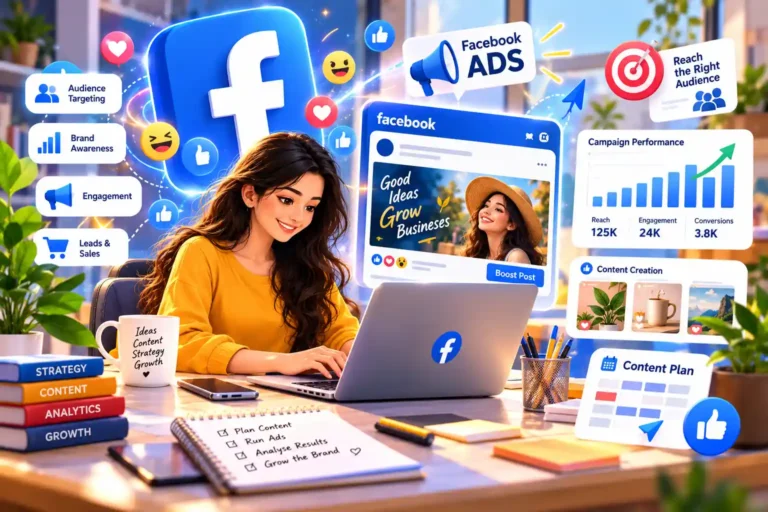
Facebook is still one of the most widely used platforms for businesses looking to reach potential customers, build brand awareness, and generate sales. But simply creating a Facebook page and posting regularly is no longer enough.
So, what actually makes Facebook marketing work today? How does Facebook decide what people see? What makes an advertisement effective? How should businesses choose their audiences, budgets, and campaign objectives?
This guide answers the most important questions businesses should understand before investing time and money into Facebook marketing.
What Is Facebook Marketing?
Facebook marketing is the process of using Facebook’s organic content, advertising tools, communities, and audience targeting features to promote a business, build relationships with customers, and achieve specific marketing goals.
It can include everything from publishing educational posts and engaging with followers to running paid campaigns for leads, website traffic, product sales, or brand awareness.
The important thing to remember is that Facebook marketing is not simply about getting more likes. A successful strategy should connect what you publish and advertise with an actual business objective.
How Does Facebook Decide Which Posts People See?
Facebook does not show every post from every page to every follower. Instead, its system tries to determine which content is most relevant to each individual user.
It looks at signals such as previous interactions, comments, shares, viewing behaviour, and other available engagement signals. If people consistently find a particular type of content useful or interesting, that content may have a better opportunity to receive distribution.
This is why businesses should focus on creating content that people genuinely want to consume rather than trying to manufacture engagement.
For example, a question that encourages customers to share their experiences can create a much more meaningful conversation than a post that simply says, “Like this if you agree.”
Is Organic Facebook Marketing Still Effective?
Yes, but it requires more thought than it did in the past.
Organic reach has become more competitive, but businesses can still build an audience without paying to promote every piece of content. The key is to publish information that is useful, interesting, entertaining, or relevant to the people you want to attract.
Consistency is also important. Posting three valuable pieces of content every week can be more effective than publishing something every day simply to maintain a posting schedule.
A good organic strategy can combine educational posts, customer stories, behind-the-scenes content, industry insights, user-generated content, and occasional promotional posts.
How Often Should a Business Post on Facebook?
There is no universal posting frequency that works for every business.
The right frequency depends on your audience, industry, available resources, and the type of content you create. Instead of asking how many posts you should publish, ask whether each post gives your audience a reason to stop, read, watch, or interact.
For many businesses, a consistent schedule of a few quality posts per week is a more sustainable approach than trying to publish multiple times every day.
Quality, relevance, and consistency should work together.
Are Facebook Groups Useful for Businesses?
Yes. Facebook Groups can be particularly useful for businesses that want to build communities around shared interests, problems, or professional topics.
A group should not feel like a constant stream of advertisements. Instead, businesses can use groups to answer questions, share useful information, start discussions, and understand what their audience actually needs.
Over time, that interaction can strengthen relationships and create a community that is more engaged than a traditional follower base.
What Are the Different Levels of a Facebook Ad Campaign?
Understanding the structure of Facebook Ads makes Facebook marketing much easier to manage.
A typical campaign has three main levels: the campaign, the ad set, and the ad.
The campaign level is where you choose the overall objective. You might want awareness, traffic, engagement, leads, or sales.
The ad set level is where you usually define your audience, budget, schedule, placements, and other delivery settings.
The ad level contains what the customer actually sees, including the image or video, primary text, headline, and call to action.
Understanding these three levels helps you identify where a campaign may be succeeding or underperforming.
Which Facebook Campaign Objective Should You Choose?
The right objective depends on what you want the audience to do.
If your goal is to introduce your brand to a new audience, an awareness-focused campaign may be appropriate. If you want people to visit a website, a traffic objective may be more relevant.
Businesses looking for enquiries may consider lead-focused campaigns, while ecommerce businesses may focus on sales or purchase-related objectives.
The important thing is to match the objective with the actual business goal. If you want sales but optimise only for engagement, Facebook may find people who are highly likely to interact with advertisements without necessarily being likely to purchase.
How Does Audience Targeting Work on Facebook?
Audience targeting is one of the most valuable parts of Facebook marketing because it allows businesses to reach people based on available demographic, geographic, interest, behavioural, and first-party data signals.
For example, a local business could focus its campaigns on people within a specific geographic area. A specialised brand could use relevant interests or other available targeting signals to reach potential customers.
However, targeting should not become unnecessarily complicated. An audience that is too broad may include many irrelevant people, while an audience that is extremely narrow may restrict delivery.
The goal is to give Facebook enough useful information to find potential customers without unnecessarily limiting the audience.
What Are Facebook Custom Audiences?
Custom Audiences allow businesses to reach people who have already interacted with their brand or provided information through appropriate channels.
Depending on the setup, this can include website visitors, people who interacted with Facebook or Instagram content, or existing customer data.
These audiences can be particularly useful for retargeting because someone who has already visited your website or interacted with your brand may be further along in the buying journey than a completely new prospect.
What Are Lookalike Audiences?
Lookalike Audiences allow advertisers to use an existing audience as a source for finding new people with similar characteristics.
For example, an ecommerce company could use an existing customer audience as a starting point for discovering new potential customers.
The idea is simple: instead of relying entirely on assumptions about who might be interested in your product, you can use information from people who have already demonstrated an interest in your business.
Which Facebook Ad Format Is Best?
There is no single format that is best for every campaign.
Single-image advertisements can work well when the message is simple and the visual communicates the offer immediately.
Video can be effective when you need to demonstrate a product, explain a concept, tell a story, or capture attention through movement.
Carousel advertisements are useful when you want to showcase multiple products, features, benefits, or stages of a process within one advertisement.
The best format depends on the audience, message, offer, and campaign objective.
How Can Businesses Create Facebook Ads That Get Attention?
Good creative needs to communicate quickly.
People scroll through crowded feeds, so an advertisement has only a short opportunity to earn attention. The opening visual, headline, or first line should make the audience understand why the content is relevant to them.
Mobile-first design is particularly important. Text should be easy to read, visuals should not be unnecessarily complicated, and the main message should remain clear even on a small screen.
Effective Facebook marketing creative is not necessarily the most elaborate creative. Sometimes a simple image with a clear message can outperform a highly designed advertisement because the message is easier to understand.
What Is the Meta Pixel?
The Meta Pixel is a tracking technology that can help businesses measure actions people take on their website after interacting with Meta advertising.
It can help businesses understand actions such as website visits, product views, leads, and purchases, depending on the events implemented.
This information can then contribute to campaign measurement and optimisation.
Why Is Conversions API Important?
Conversions API can complement browser-based tracking by sending event information from a server to Meta.
As privacy restrictions and browser limitations have changed the digital advertising environment, relying on only one form of tracking can create gaps in measurement.
Using appropriate browser and server-side tracking can give businesses a more complete view of important customer actions, provided the implementation is configured correctly and follows applicable privacy requirements.
What Should You Track in a Facebook Campaign?
Before launching a campaign, decide what action actually represents success.
For an ecommerce business, that might be a purchase. For a service business, it could be a qualified enquiry or consultation booking. For another business, it might be a registration or application.
Metrics such as reach and impressions are useful for understanding exposure, but they do not necessarily tell you whether the campaign is producing business results.
Cost per result, conversion rate, click-through rate, and return on ad spend can provide more meaningful insight depending on the campaign objective.
How Much Should You Spend on Facebook Ads?
There is no fixed budget that guarantees success.
Your budget should depend on your business objectives, audience size, industry competition, average customer value, conversion rate, and how much you can realistically afford to test.
Facebook offers daily and lifetime budgets. A daily budget can work well for ongoing campaigns, while a lifetime budget can be useful for campaigns with a fixed start and end date.
Rather than spending a large amount immediately, businesses can start with a controlled test, collect meaningful data, and increase investment when the numbers justify it.
How Long Should You Run a Facebook Campaign Before Judging It?
New campaigns usually need sufficient time and data before their performance can be evaluated properly.
Making changes every few hours because the campaign has not generated an immediate result can make it difficult to understand what is actually working.
A better approach is to establish your success metrics before launching the campaign and then evaluate performance over a meaningful period.
The exact timeframe will depend on your budget, objective, conversion volume, audience, and sales cycle.
What Is Creative Fatigue in Facebook Advertising?
Creative fatigue happens when an audience repeatedly sees the same advertisement and gradually becomes less responsive to it.
You may notice this through increasing frequency, declining engagement, higher costs, or falling conversion performance.
Refreshing your creative can help prevent the audience from becoming overly familiar with the same message.
Testing different visuals, hooks, headlines, offers, and formats can also help identify what continues to attract attention.
What Are the Most Common Facebook Marketing Mistakes?
One of the most common mistakes is focusing on vanity metrics instead of business outcomes. A campaign can generate thousands of likes and still fail to produce meaningful sales or enquiries.
Another mistake is choosing an audience without a clear understanding of the ideal customer. Businesses sometimes make their targeting so broad that a significant portion of the budget reaches people who are unlikely to convert.
Creative fatigue, insufficient testing, weak landing pages, poor tracking, and frequent campaign changes can also affect performance.
A strong Facebook marketing strategy considers the entire customer journey rather than treating the advertisement as an isolated piece of content.
Why Is the Landing Page Important?
Imagine someone clicks your advertisement because they are interested in what you offer. They arrive on your website, but the page loads slowly, the information is confusing, and there is no obvious next step.
The advertisement may have done its job, but the landing page has lost the opportunity.
Your landing page should support the promise made in the advertisement. The message, offer, design, and call to action should feel connected from the first click to the final conversion.
Which Metrics Matter Most in Facebook Marketing?
The most important metrics depend on your objective.
Reach tells you how many people were exposed to the content, while impressions show how many times it was displayed.
Click-through rate helps indicate whether people are interested enough to click.
Cost per result helps you understand how efficiently you are achieving the campaign objective.
Conversion rate shows how effectively visitors complete the desired action.
Frequency tells you how often the same audience members are seeing your advertisement.
For ecommerce campaigns, return on ad spend can be particularly useful because it connects advertising expenditure with attributed revenue.
Should Businesses Focus on Organic or Paid Facebook Marketing?
Ideally, businesses should understand how the two can complement each other.
Organic content can help establish credibility, demonstrate expertise, and create relationships with existing followers. Paid advertising can extend your reach and help you target specific audiences at scale.
A successful organic post can also provide useful insight into what your audience finds interesting. That does not mean every popular organic post should automatically become an advertisement, but it can give you ideas for future paid creative.
Combining both approaches can make Facebook marketing more effective than relying entirely on one side of the platform.
How Can a Business Build a Successful Facebook Marketing Strategy?
Start with the business goal rather than the platform.
First, identify who you want to reach and what problem you are solving for them. Then create content that addresses their interests, concerns, and needs.
Once you understand the audience, determine whether organic content, paid advertising, or a combination of both is appropriate.
For paid campaigns, select the objective that matches the desired outcome, define a sensible audience, create multiple creative variations, install appropriate tracking, and establish the metrics you will use to judge performance.
After the campaign has collected enough meaningful data, analyse what happened and use those findings to improve the next campaign.
Is Facebook Marketing Still Worth It?
Yes, but the approach needs to be strategic.
Facebook is no longer a platform where businesses can expect consistent results simply by posting promotional messages and waiting for customers to respond. Competition for attention is high, and audiences are more selective about what they consume.
Businesses that understand their customers, create useful content, use paid advertising strategically, track meaningful actions, and continuously improve their campaigns can still find significant opportunities on the platform.
Ultimately, successful Facebook marketing is less about chasing likes and more about building a system that turns attention into meaningful customer relationships and measurable business results.
Ready to take your brand beyond likes and clicks? Visit my website or my instagram and explore how strategic digital marketing can turn attention into growth.